
Overview. This page documents the location of the tropical rainbelt over Africa and its seasonal migration. It also highlights how this movement relates to other large-scale climate features, including drylines and heat lows. Data is up to date as of Loading….
Across Africa, drylines such as the Congo Air Boundary (southern Africa) and Intertropical Discontinuity (northern Africa) “sandwich” the rainbelt from the north and south. Heat lows on either side of the equator act to draw the rainbelt toward the hemisphere experiencing stronger surface heating.
Current Conditions. Below is a near–real-time map of African land surface temperatures, an accessible proxy for soil moisture. Overlaid are the current positions of the tropical rainbelt, heat lows, and drylines.
Land Surface Temp (°C)
Heat Low Strength (K)
Map Features
History and forecast. The figure below shows the recent evolution and short-term forecast of the African tropical rainbelt, together with associated surface features such as heat lows and the Congo Air Boundary (CAB).
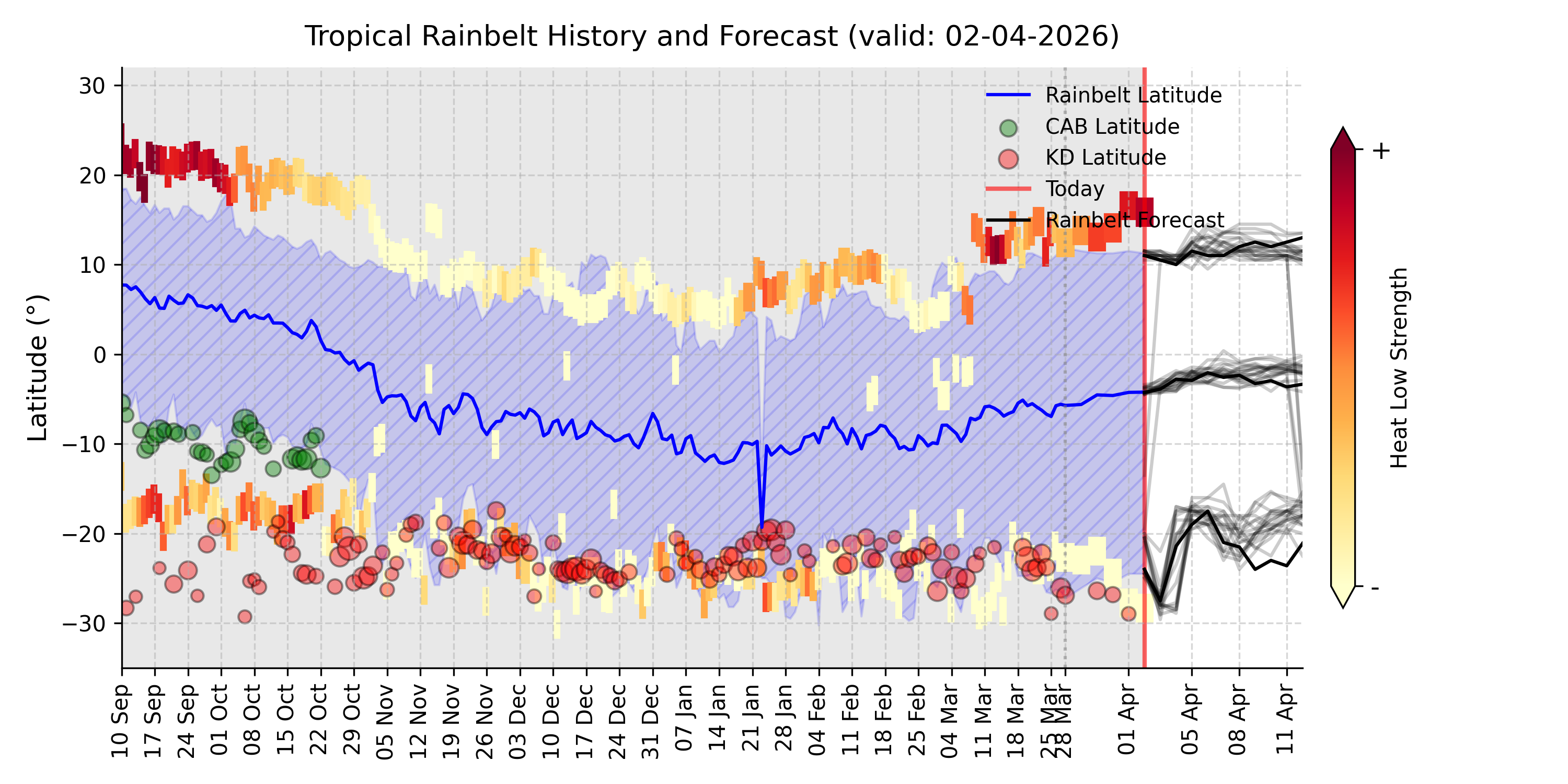
The blue band represents the observed position and north–south extent of the rainbelt, while green circles indicate the latitude and extent of the CAB. Colored bars show the latitude and thermal strength of northern and southern African heat lows, which influence the rainbelt’s migration through differential surface heating. To the right of the red line marking today, the ensemble forecast (black lines) shows the projected movement of the rainbelt over the next ten days. The shaded bars at the bottom indicate the probability of Congo Air Boundary (CAB) and Kalahari Discontinuity (KD) occurrence through time.
The onset of the southern African summer monsoon typically occurs from November onwards, after which the Congo Air Boundary does not form. The date of this onset varies greatly between years and is often difficult to predict, as it depends on weather-scale processes with limited inherent predictability (e.g., Rossby wave interactions; Knight and Washington, 2023).
Data Sources
- MSG-3 SEVIRI 11:00UTC Land Surface Temperature. Data available at https://datalsasaf.lsasvcs.ipma.pt/PRODUCTS/MSG/MLST/.
- GSF 00:00 UTC atmospheric analysis. Data available at https://nomads.ncep.noaa.gov/
- GSF 00:00 UTC ensemble forecast. Data available at https://nomads.ncep.noaa.gov/
- Dryline gridcells detected with the canny edge method of Howard and Washington (2019) available on GitHub.
Feedback
This page is experimental and in development. Please get in touch with any suggestions.
The following features are known to interact with the location of the rainbelt and will soon be added to the tracker:
- Cloud bands
- Tropical cyclones
- Upper-level wave breaking
Supporting publications
Attwood, K., Washington, R. and Munday, C. (2024) ‘The Southern African Heat Low: Structure, Seasonal and Diurnal Variability, and Climatological Trends’, Journal of Climate, 37(10), pp. 3037–3053. Available at: https://doi.org/10.1175/JCLI-D-23-0522.1.
Howard, E. and Washington, R. (2019) ‘Drylines in Southern Africa: Rediscovering the Congo Air Boundary’, Journal of Climate, 32(23), pp. 8223–8242. Available at: https://doi.org/10.1175/JCLI-D-19-0437.1.
Howard, E. and Washington, R. (2020) ‘Tracing Future Spring and Summer Drying in Southern Africa to Tropical Lows and the Congo Air Boundary’, Journal of Climate, 33(14), pp. 6205–6228. Available at: https://doi.org/10.1175/JCLI-D-19-0755.1.
Knight, C., & Washington, R. (2024). ‘Remote Midlatitude Control of Rainfall Onset at the Southern African Tropical Edge’. Journal of Climate, 37(8), 2519-2539. Available at: https://doi.org/10.1175/JCLI-D-23-0446.1
Munday, C., Washington, R., Engelstaedter, S., Zilli, M., Harbord, S., Knight, C., Attwood, K. and Hart, N. (2025). Southern African Climate Change: Processes, Models, and Projections. WIREs Climate Change, 16(5). Available at: https://doi.org/10.1002/wcc.70025